•.
Canon EF 50 1.2L USM
Review of a Classic
Peter
Kun Frary
.
•
The 46-degree coverage of the 50mm lens is equivalent to the sweet spot of the human eye, making it a popular walk-around lens for full-frame cameras. This natural perspective makes it easy to pre-visualize images. Thus, the venerable 50mm prime lens is often referred to as a normal lens.
Mall Flora | EOS 5D MK II and EF 50 1.2L USM | F1.4, 1/2500, ISO 160

And, while the Canon EF 50 1.2L USM is technically a “normal” lens, the fast F1.2 aperture and unique optical characteristics make it anything but normal.
This review consists of my opinions and observations as a hobbyist. No scientific measurements, MFT charts or pixel peeking comparisons are found here.
 Compatibility
The EF 50 1.2L USM lens works on Canon EOS SLR and DSLR cameras, both full frame and APS-C (1.6X), such as the EOS 5D MK IV and Rebel SL3. It also works on EOS R and M series mirrorless cameras with a mount adapter. It does not fit FD mount and non-Canon cameras such as Pentax, Nikon, Fuji, etc.
 Construction
Introduced in January 2007, the EF 50 1.2L USM is an impressive feat of engineering: F1.2 aperture, ring-type USM, beefy construction and weather resistant seals. It has gaskets on the lens mount, under switches, and behind the focus ring. To complete weather sealing, Canon requires the use of a filter.
Canon EF 50
1.2L USM | Killer weed for low light junkies 'n bokeh cats

Build quality is first rate and it feels solid and reassuring in hand. The speckled matte finish black is handsome and stealthy. For a 50mm lens it's heavy (590g) but small and stealthy compared to a typical zoom. A twist-on hood, storage bag and manual in a dozen languages are included.
Fountain | EOS
5D, EF 50 1.2L USM | F1.2, 1/4000, ISO 100

Compared to a zoom, the optical design is simple: 6 groups and 8 elements. It has an aspherical element but no floating element. Flare is well controlled and, unlike most zooms, I've had no flare problems with sunsets or other bright lights in the frame.
 Auto Focus
A ring-type USM (Ultrasonic Motor) achieves focus by driving the front lens group. AF is reasonably fast and sure-footed on my 6D MK II, 6D and 90D bodies. AF is faster and more reliable than my EF 50 1.4 USM but not as fast or reliable as my EF 24-105 4L IS USM. The razor thin depth of field (DOF) makes AF more challenging compared to slower aperture optics. Accurate focus with narrow DOF requires precise and thoughtful placement of AF sensors on subjects. For best results you need to control AF and not let the camera select AF points for you.
Sweeping landscapes and well lit situations rarely present AF problems. However, shooting at close focus (e.g., 1 meter) in low light can be problematic for 5D MK II or 6D single axis outer AF points. It is best to use the more sensitive center AF point for these situations. Fortunately, the center point is reliable and accurate. My 6D MK II was less troublesome in this respect due to all cross-type AF sensors. High end AF systems with all cross sensors work best with this lens.
SHOPSHOP | EOS
5D MK II and EF 50 1.2L USM | F2.0, 1/800

The front element does not rotate and the barrel does not expand or contract during focusing. However, the front element moves slightly within the barrel during AF. Of course, being an USM lens, it is silent during AF.
It has FTM (Full Time Manual Focus), allowing manual focus without switching out of AF mode. The focus ring is large, smooth turning and covered with ribbed rubber. It's not as silky as a manual Nikkor but above average for an AF lens. If you prefocus manually, the distance window in meters and feet is useful. It has a DOF scale albeit spacing is too tight for critical use. It focuses close enough for head shots and small details (.45m/1.5 ft.).
Ginger at Aliʻiolani Hale | 5D and EF 50 1.2L USM | F5.6

There has been talk on internet forums of back-focusing problems at 1 meter or less between F2 and 4. Some folks say back-focusing is inherent to the design (no floating element). I wasn't able to duplicate these problems and focus with the center AF point of my 5D MK II, 5D MK IV and 6D MK II was generally accurate, albeit less sure-footed than my EF 17-40 4L USM and 24-105 4L IS USM zooms.
Filters
Focus
operation requires a small movement of the front element group
within the barrel. The air
space between element group and barrel is a
point of entry for dust and water. Hence Canon requires a
filter
to
complete
weather
sealing. The
72mm
filter size makes for expensive filters, and is at odds with
the 77mm size used for many L optics.
Judging from the small diameter of the
front element, Canon
could have designed this lens with a smaller filter size
(58mm?). I assume
the extra space around the front element allows
for use
of a deeper hood and thicker filters.
The
manual recommends removing the hood while
using
a polarizing filter. If you have long fingers
it's not difficult to rotate
the filter with hood intact.
Tall Ship | 5D and EF 50 1.2L USM | F8, 1/500, ISO 200

 Image Quality
This isn't the sharpest 50mm prime I have owned.
That honor goes to the EF 50 2.5 CM and RF 50 1.4L VUM. However the EF 50 1.2L USM
is very good.
It's sharp from wide open—well, at least the center—all the way to F16 (smallest aperture).
Our Lady of Peace | Honolulu, USA | EOS 5D and EF 50 1.2L USM at F1.2

Pixel Level Detail | EOS
5D and EF 50 1.2L USM at 1.2

With that said, most people buy this lens to shoot at or near wide-open apertures. The center of the image circle has an attractive glow, i.e., a diffused and softened look, that is extremely flattering to human faces.
 Light Fall-Off
One of the reasons to own a 50mm lens is for available light photography. At F1.2, you can take pictures unobtrusively in extremely dim light. However, like all large-aperture primes, there is some light fall-off when used wide open. Stopping down significantly reduces light fall-off. With that said, I rarely notice light fall-off even at F1.2 save for white-wall or blue-sky tests. However, DPP and Lightroom are great at correcting light fall-off if needed. No obvious light falloff in the image below:
Reine de Paix Honolulu | EOS 5D & EF 50 1.2L USM at F3.5, 1/500, ISO 200

If you shoot with a APS-C body, e.g., Rebel, 80D or 90D, light fall-off is mostly a moot point as much of the image circle is cropped out.
 Coma
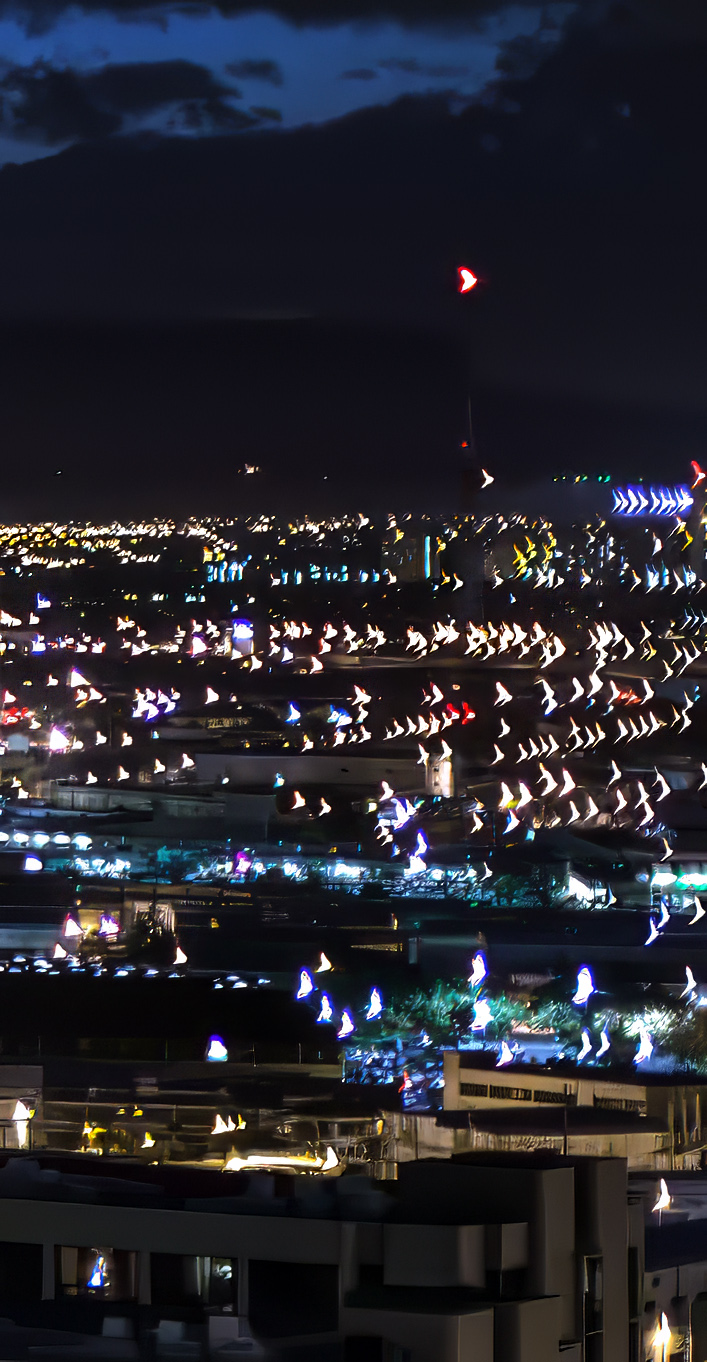
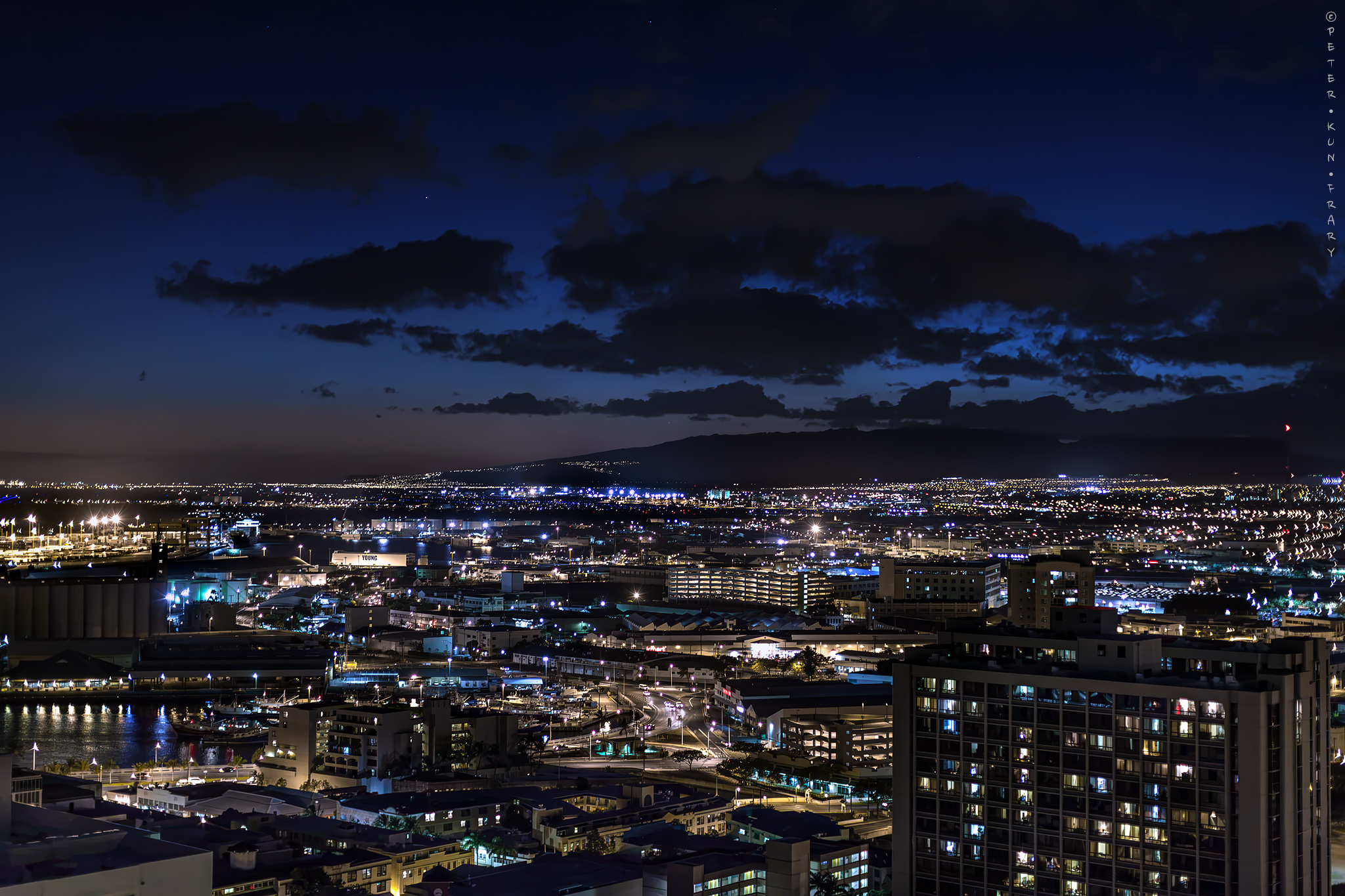
One of the few things I dislike about the EF 50mm 1.2L USM is the heavy coma at larger apertures. What is coma? It's a flare-like aberration where sharp points of light, such as stars or distant street lights, are rendered like bird wings or comet tails. The image on the right—cropped from the right side of the EF 50 1.2L USM scene below—suffers from bird wing-like coma.
Wide open at F1.2, the center and middle sections of the frame are coma-free. The good news is that coma may be reduced or removed by stopping the lens down. By F4, coma is mostly gone. By F5.6, coma is completely gone. Obviously, this is not an astronomy lens but is fine for city nightscapes at F4 and smaller apertures. |
 |
Honolulu Harbor View | EOS 5D MK II and EF 1.2L USM at F2.0. Coma is visible from F1.2 to 2.8 along the periphery.
Bokeh
Most people buy this lens because they want creamy, smooth bokeh for portraits. The soft whirl of an out-of-focus background really makes subjects pop. Plus, the inherent softness and slight glow are flattering for human faces. This 8-blade diaphragm maintains a pleasant, circular-shaped aperture even when stopped down with brilliant highlights in the background.
Mall Leaves | EOS 5D, EF 50 1.2L USM | F1.2, 1/1600

The melting of background shapes and hues is strongest at F1.2, but is still prominent and pleasant stopped down to f/2.8 or even f/4 if your subject is close and well separated from the background.
At F1.2 the images take on a quasi painterly quality due to reduced contrast. A glowing quality is typical within the swirl of ultra smooth bokeh.
DOF is so shallow at F1.2 focus must be perfect. Even being off a few millimeters spoils the image. It took me a long time to get used to precisely picking the point of AF. I had to disable auto AF point selection for most subjects except those at infinity focus.
Queen's Court | Honolulu | EOS
5D MKII and EF 50 1.2L USM | F1.2

Normal
Perspective
Like wide-angle lenses, objects nearer in the frame, i.e., within a couple of feet, appear slightly exaggerated in size. For example, full- or upper-body images look natural. But step closer for a tight head-and-shoulders portrait, and the nearest facial feature, e.g., nose or chin, may appear slightly broad and flat. The above-mentioned is why the 50mm optic is generally not regarded as a headshot lens on full-frame cameras. Instead, it shows off your subject best when you step back a little or feature your subject in their surroundings.
Mai Tai Face | EOS 5D, EF 50 1.2L USM | F3.5, 1/400, ISO 400

 Musings
The EF 50 1.2L USM is not the sharpest tool in the shed, but it is oozing with optical character due to the F1.2 aperture and lack of a floating element to control spherical aberration (the inability to converge light into a single point). Indeed, this spherical aberration imparts much of the charm of this lens: a soft halo effect and a loss of contrast and sharpness at large apertures. If you're a portrait or wedding photographer craving ultimate bokeh, flattering skin textures, and an otherworldly glow or halo, especially in the highlights, this is the lens for you.
Of course, if you stop down to at least F4—preferably F5.6 or F8—this lens can serve as a very good normal lens for landscapes, architecture, and travel snaps. But then you'd be better served by the less expensive and slightly sharper EF 50 1.8 STM (or RF 50 1.8 STM on RF mirrorless) or EF 50 1.4 USM.
Mo' Ginger | EOS 5D, EF 50 1.2L USM at F2.8, 1/100 and ISO 200

I lost interest in portraits a decade ago and use my 50mm primes for landscapes, nightscapes, and street scenes. The softing glowing bokeh and halo effect so conducive to elegant portraits are not usually good for landscapes. I searched but was unable to find a technically excellent 50mm lens in EF mount: most suffered from heavy coma, chromatic aberration, and extreme softness wide open. However, I found one in RF mount—the RF 50 1.4L USM. It was pricey and is a bit clinical for flattering portraits but amazing for wide open use in low light, including city nightscapes with points of light. No comet tails!
This fast aperture also results in a bright optical viewfinder, making it easier to compose in dim light. Fast optics also have smoother bokeh. The soft whirl of an out of focus background makes your subject pop. Finally, a compelling reason to use a 50mm lens is the relatively petite size.
Iolani Palace | EOS 5D, EF 50 1.2L USM | F5.6, 1/800, ISO100

 Final Blurb
This is the daddy-o grande of normal primes: well made, sharp when stopped down, and a riot of creamy bokeh. If you're a hard-core bokeh lover and portrait shooter, the EF 50 1.2L USM just may be your ticket to the land of dreamy images.
Please help support this site by purchasing this lens at Amazon.
 Features and Specs
- Focal Length: 50mm
- Aperture Range: f/1.2 - f/16
- Lens Construction: 8 elements in 6 groups (1 aspherical element)
- Diaphragm Blades: 8 circular aperture blades
- Diagonal Angle of View: 46° (full-frame cameras)
- Closest Focusing Distance: 1.48 ft. / 0.45 m
- Maximum Magnification: 0.15x (or 1:6.7)
- Autofocus Motor: Ring-type USM (Ultrasonic Motor) with full-time manual focus override
- Filter Size: 72mm
- Weather Sealing: Dust- and humidity-resistant with mount gasket
- Included Accessories: ES-78 lens hood and LP1214 lens case

- Dimensions: 3.4 in. x 2.6 in. (85.4 mm x 65.5 mm / max diameter 85.8 mm)
- Weight: 19.2 oz. (545 g)

1/10/2009 | Revised 10/18/2026
 Source Materials
Canon EF
Lens EF50mm F1.2L USM Instruction
Manual. Tokyo:
Canon, 2006 (CT1-7567-001).

©Copyright 2009-27 by Peter Kun Frary | All Rights Reserve |
 •••••••
 •••••••
 •••••••
 •••••••
 •••••••