•.
Canon
EF 50 1.8 STM
Normal Lens on a Budget
Peter
Kun Frary
.
•
Canon's EF 50mm 1.8 STM debuted in 2015, the last in a line of EF mount “nifty-fifty” designs originating in 1987. During the 1980s, the nifty-fifty was often sold as a kit lens with new cameras such as the EOS 650 and 620. While the kit lens role was soon taken over by zooms, the humble nifty-fifty series continues to live on in countless camera bags.
Nu'uanu Valley | EOS 6D and EF 50 1.8 STM at F4.5

Writing as a hobbyist, herein are my opinions and observations on Canon's EF 50mm 1.8 STM. No scientific measurements or MFT charts will be found here.
 Why a 50mm Lens?
Why buy a prime lens like the EF 50 1.8 STM when most zooms include 50mm? Even the slowest 50mm primes feature apertures of F1.8 to 2.0, fast enough to shoot without flash in candle light. Plus, fast apertures yield a pleasingly defocused background to help make subjects standout from the background.
The natural perspective and fast aperture make the EF 50 1.8 STM ideal for general photography, especially travel, low light, and street photography with a full-frame camera. On an APS-C cropper, e.g., Rebel or 90D, it's a short telephoto and well suited for portraits and indoor sports.
Canon's EF 50 1.8 STM is among the smallest and lightest lenses available, only beaten for portability by pancake designs like the EF 40mm 2.8 STM. If you're a traveler, the 160g EF 50mm 1.8 STM is an easy carry if you desire a backup lens or a fast optic for low light.
Finally, repeated use of a single focal length helps one learn to pre-visualize images. Once mastered, no stepping back and forth or fiddling with a zoom ring. Simply raise the camera to eye and frame. Picture taking becomes simple and natural.
 Compatibility
The EF 50 1.8 STM lens works on all Canon EOS SLR and DSLR cameras, both full frame and APS-C (1.6X), such as the EOS 5D MK IV and Rebel SL3. It will also work on EOS R and M series mirrorless cameras with a mount adapter. It does not fit FD mount cameras or non-Canon cameras such as Pentax, Nikon, Fuji, etc.
 Construction
The EF 50 1.8 STM is slightly smaller and heavier than the prior model, the EF 50 1.8 II, aka nifty-fifty. It is so small and light that I sometimes feel like I forgot to mount a lens when I pick up my camera. However, the build quality is significantly better than the prior model: metal mount, sturdier barrel and AF/MF switch, a larger focus ring, a grippy matte finish, and a faster AF motor (STM).
Canon EF 50 1.8 STM | Photo courtesy Canon Inc.

Despite all the little improvements, this is still a bare-bones design: no image stabilization (IS), distance scale, and DOF markings. It also uses an odd filter size, 49mm, rather than the more common 52mm or 58mm sizes found on many small Canon lenses.
 Image
Quality
The EF 50 1.8 STM has the same optical design as the prior nifty-fifty, but with improved lens coatings and close focus ability. Wide open at F1.8, my sample is somewhat sharp in the center frame but extremely soft and dark in the periphery: okay for dreamy portraits and twilight bigfoot sightings. That’s about it. I'd never use this lens wide open for a landscape or night sky. F1.8 and F2.0 are terrible. Save them for low-light emergencies. I think of the EF 50 1.8 STM as a F2.8 lens.
On APS-C cameras such as the 90D and Rebel, corner darkening and softness aren't as noticeable since nearly half the image circle is cropped out.
Sharpness and contrast in the periphery improve considerably by F2.8, and light falloff is nearly gone by F4. Indeed, images are extremely vivid and sharp once stopped down to the sweet spot apertures. On full-frame cameras, optimal sharpness across the frame falls between F5.6 and F11. The old adage “F8 and be there” rings true here!
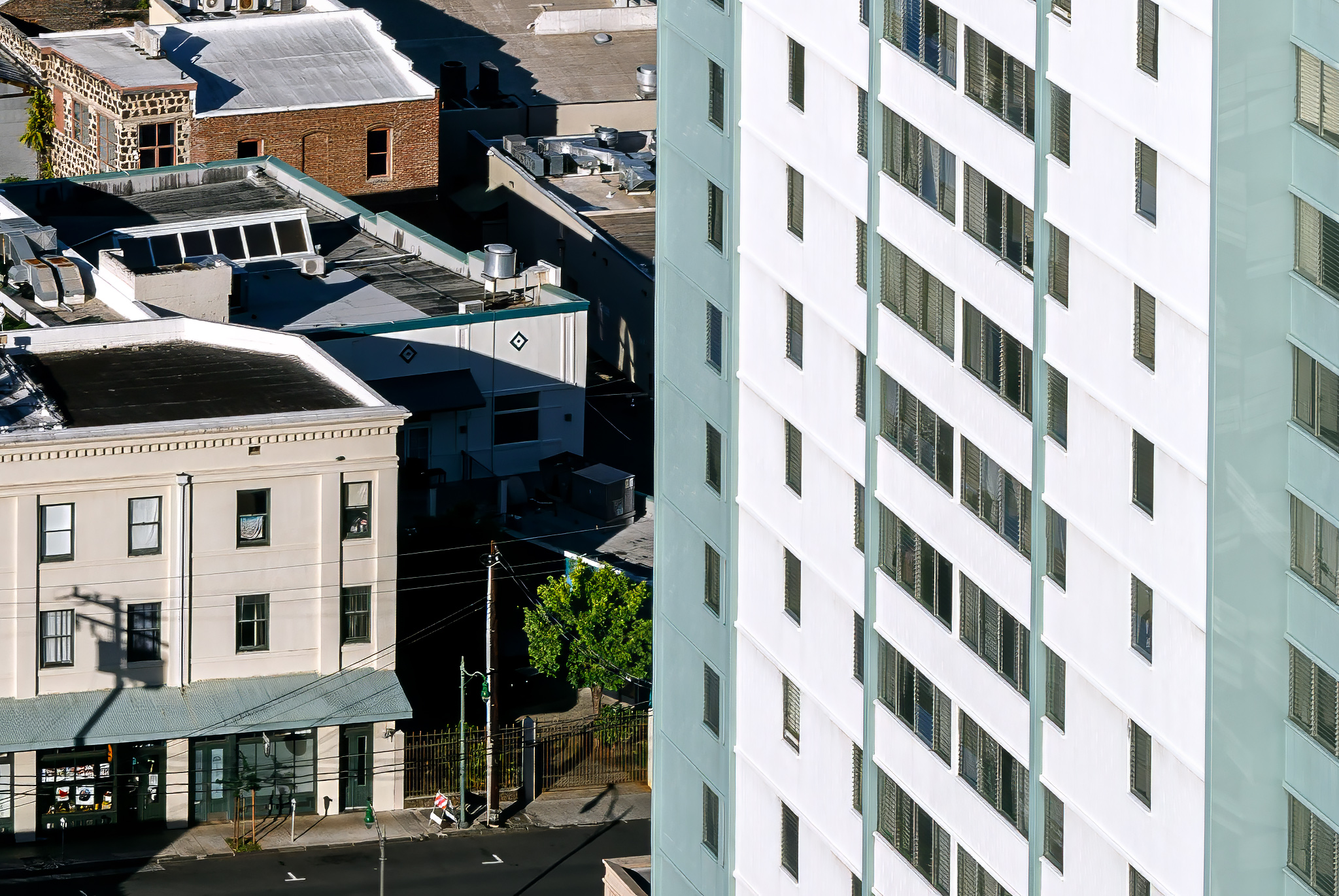
Honolulu Harbor & Chinatown | EOS 5D MK IV and EF 50 1.8 STM at F8 | Corners and edges are razor sharp at F8.

Crop | 100% crop of the bottom right corner of the above image.
 Coma
Coma is not visible in most types of images but, if you're a night photographer, coma may be a concern. What is coma? It's a flare-like aberration where sharp points of light—stars or distant street lights—are rendered like small wings or comets.
One of the disappointing things about my prior nifty-fifty was the heavy coma at large apertures. Sadly, the EF 50mm 1.8 STM suffers from the same level of coma. Stop down 2 to 3 stops to get rid of the coma, but then you may need to use a tripod or raise the ISO.
Below is a Honolulu nightscape shot at F5.6, the coma-free sweet spot of the EF 50 1.8 STM.
Honolulu | EOS 5D MK IV and EF 50 1.8 STM at F5.6, 0.8 sec and ISO 400

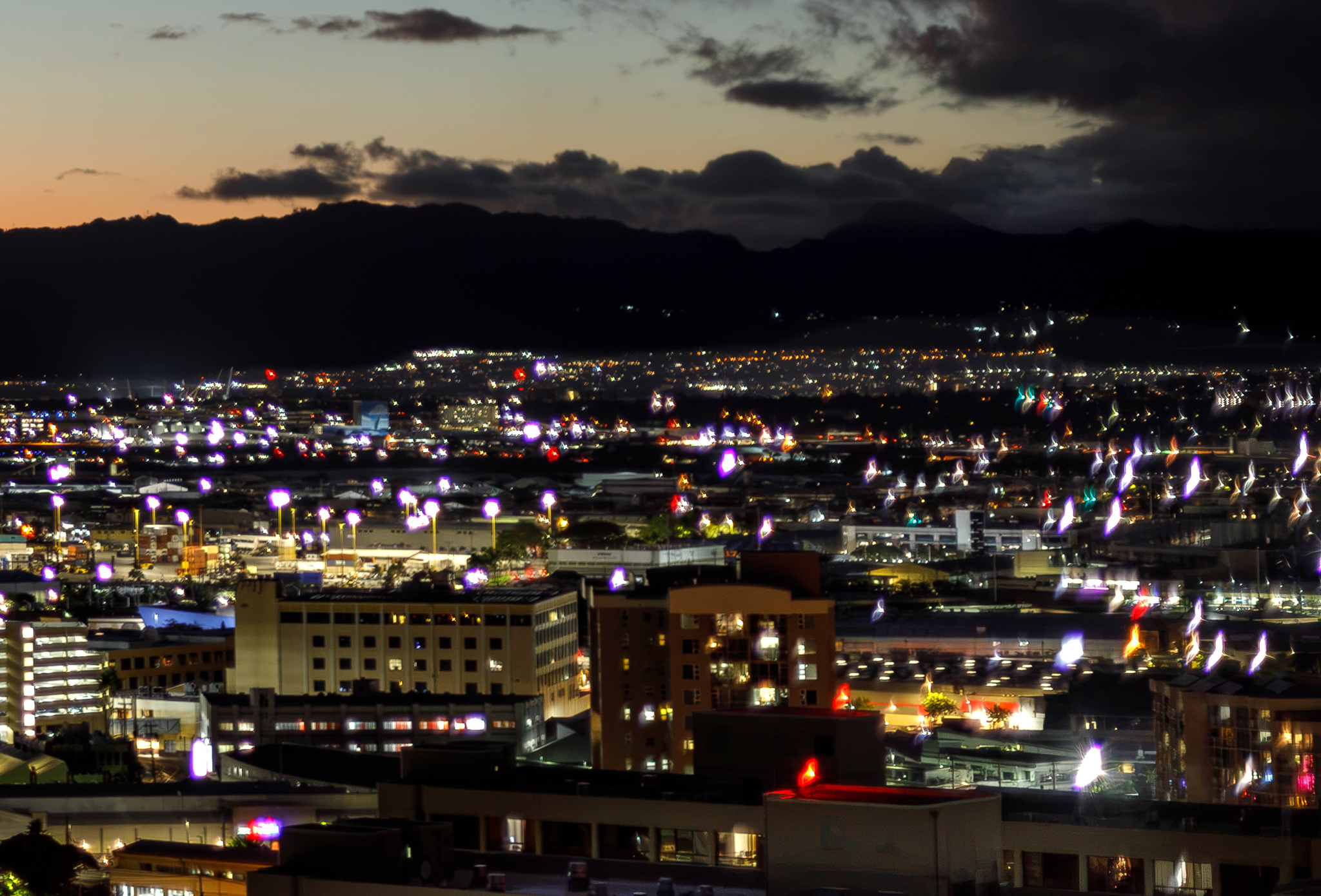
The image below is a crop from the right side of the above scene but shot at f/1.8. While the center is somewhat sharp, the periphery is hazy and soft. The points of light along the periphery are rendered as wing-shaped flares with strong chromatic aberration. Bright lights are presented as ugly blobs.
Crop | EOS 5D MK IV and EF 50 1.8 STM at F1.8, 1/15 sec and ISO 400
Stopping Down Changes Everything
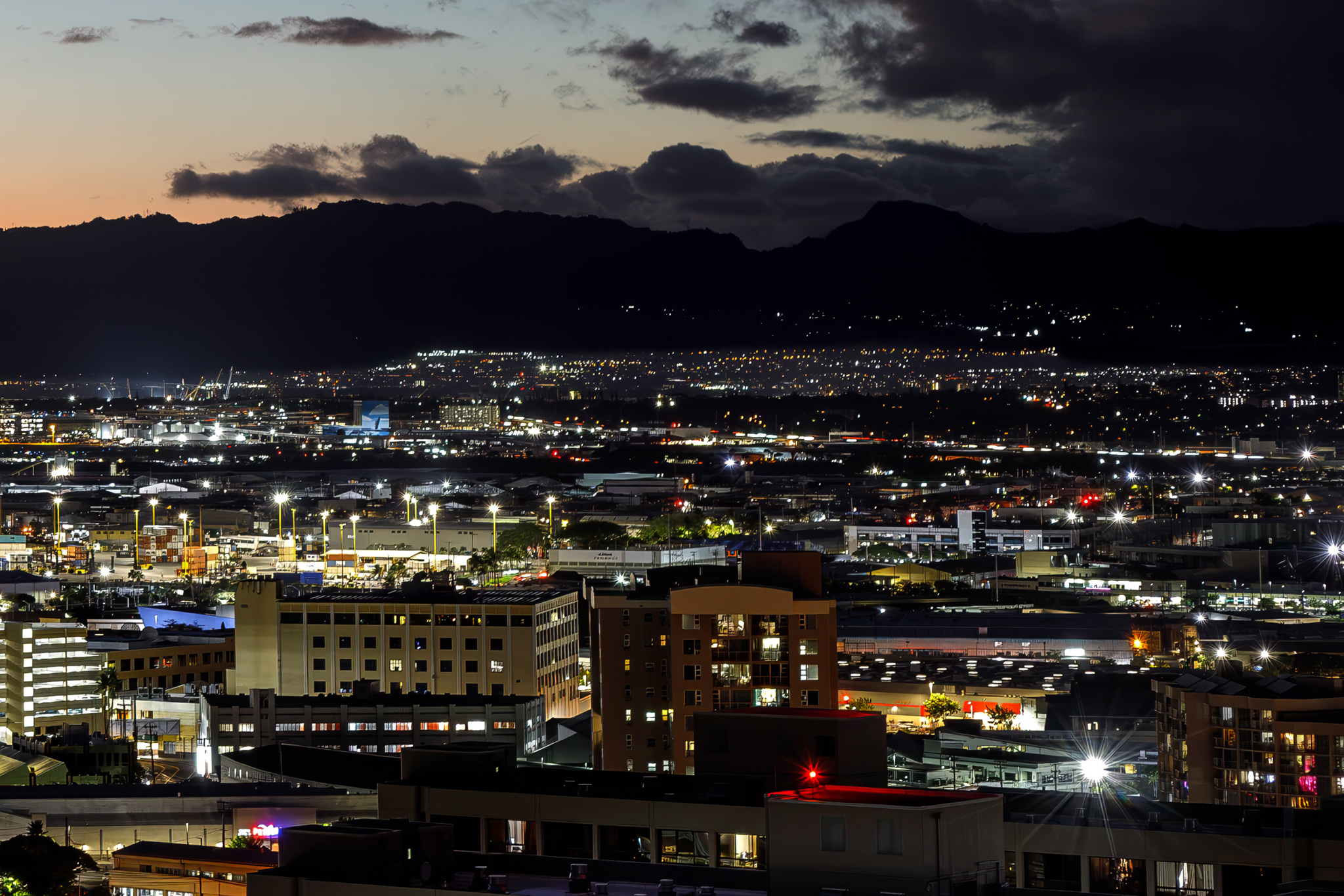
The good news is that both coma and chromatic aberration are progressively reduced as the lens is stopped down. At F2.8, the entire frame becomes sharper, chromatic aberration is significantly reduced, and the coma wings along the periphery are smaller. A usable nightscape for those who aren’t pixel-peepers. By F4, the wings are replaced with tiny comet tails. By F5.6, the distant points of light look like, well, points of light. Brighter lights appear as sunstars. In fact, the entire image has more contrast and is exceptionally sharp. Here’s a crop of the far right side of the same scene taken at F5.6. Big difference, huh?
Crop | EOS 5D MK IV and EF 50 1.8 STM at F5.6, 0.8 sec and ISO 400
Like the EF 50 1.4 USM and EF 50 1.2L USM—lenses with similar levels of coma—this lens is not ideal for city nightscapes or astro. Stopping down to nix coma and edge softness defeats the benefit of a large aperture. However, this lens is wonderful for most other uses for a 50mm lens. For example, for portraits with city lights in the background, distant points of light are rendered as round bokeh balls instead of wings.
When Canon's R series cameras debuted, the nifty-fifty was reborn as the RF 50 1.8 STM. It focuses closer and has slightly better edge sharpness and control of coma compared to the EF 50 1.8 STM. If you are well-heeled, the RF 50 1.4 VCM has amazing edge sharpness and coma control. But then, it costs almost ten times as much as a nifty-fifty and is three times as big.
 Macro
A quasi-macro minimum focus distance of just under 14 inches (.21x) is 4 inches closer than the prior model, close enough for medium-sized flowers and flat art. However, unlike the nifty-fifty before it, the EF 50 1.8 STM exhibits only mild barrel distortion at two meters and nearer. Indeed, the distortion would probably only be noticed when a straight line runs parallel to the edge of the frame, e.g., an architectural details like a door or window. Of course, a few clicks in Photoshop, Lightroom, or Canon's DPP can correct this distortion.
Ti Leaf | EOS 6D and EF 50 1.8 STM at F4 | Minimum focus distance is just under 14 inches (.21x). Even at F4 bokeh balls are still visible in the background.

Bokeh
I love the soft whirl of a defocused background, and the seven-blade diaphragm of this lens does not disappoint. Set to a large aperture, the EF 50mm 1.8 STM renders smooth bokeh and pleasantly round highlights, helping subjects to stand out. This is a wonderful portrait lens for APS-C cameras like the Rebel or 80D.
Portrait Bokeh | EOS SL1 and EF 50 1.8 STM at F2.8

 Focus
 Auto Focus
AF speed and reliability are markedly better than the prior nifty-fifty, but slow compared to a ring-USM zoom like the EF 24-105 4L IS USM. Focus is accurate and rarely misses even in low light. Front element extension (nested barrel) is used to focus. The STM motor is quieter than the prior model, albeit not silent, emitting a high pitched "heeek" audible in a quiet room. In fairness, volume is pianissimo and will not be noticed on the street or in a room with normal conversation levels.
Movie servo AF on a 90D and 5D MK IV is buttery smooth and works well for touchscreen pulls. Focus noise, while low volume, is recorded by built-in camera mics during quiet video clips. I always use an external shotgun mic and/or outboard audio, and AF sound is not recorded. For static subjects like a talking head, you could prefocus and disable movie servo.
I've used this lens on a 5D MK II, 5D MK IV, 6D, 6D MK II, 70D, 80D, 90D and SL1. One thing that jumped out at me is that it focused accurately on all my cameras. Unlike my zooms, no AFMA was needed!
Manual Focus
Manual focus (MF) is accomplished via focus-by-wire: the ring merely activates the focus motor and is not mechanically coupled to the lens. Manual focus is smooth, but control isn't as good as a mechanical ring. The MF ring is thin but wider than the original nifty-fifty's ring and better positioned.
Rain Drops | EOS 6D and EF 50 1.8 STM | Sharp details and bokeh balls at F2.8

Like USM lenses, it has Full-Time Manual (FTM), allowing AF override without flipping a switch: simply turn the MF ring while half depressing the shutter button. FTM is only active when the shutter button is half-depressed.
 Canon ES-68 Lens Hood
The groove on the barrel is for the Canon ES-68, a locking bayonet hood. It attaches to the outer barrel, protecting the protruding inner barrel from frontal impact and flare. At $32.99 it's pricey but worthwhile for the protection.
Canon ES-68 Hood | Support this website by purchasing this hood at Amazon.

If you cringe at the cost of the ES-68, consider the JJC LH-68, a clone of the ES-68. It is available about 1/3 the cost of OEM. I don't own the JJC LH-68 but other JJC hood models I use are only a notch below OEM quality and appearance.
Palm Leaf | EOS 5D MK II and EF 50 1.8 STM at F5.6

 Final Blurb
This slightly improved nifty-fifty boasts accurate AF, smooth video pulls, a sturdy build, a low price point, and vivid and sharp images when stopped down. In other words, the same image quality as the prior model but in a more refined package. If you're not a startrails or city nightscape shooter, this is a great little lens.
Finally, please help support this website by purchasing this lens at Amazon.
 

 Features and Specs
- Focal Length: 50mm
- Aperture: F1.8 to
22
- Elements: 6 elements in 5 groups
- Lens Coating: Super Spectra
- Lens Format Coverage: full-frame
- Lens Mount: EF
- Auto Focus motor: STM
- Min. Focusing Distance: 13.8" / 35 cm
- Maximum Magnification: .21X
- Angle of View (Diagonal): 46°
- No. of Diaphragm Blades: 7
- Filter Size: 49mm
- Included Accessories: lens caps

- 5.6 oz / 160 g
- 2.7 x 1.6 in / 69.2 x 39.3mm

08/11/2017 | Revised 10/06/2026

©Copyright 2017-26 by Peter Kun Frary | All Rights Reserved
|
 •••••••
 •••••••
 •••••••
 •••••••
 •••••••