What's the difference between home stereo speakers and studio monitors? Studio monitors let you hear exactly what was recorded whereas home speakers deliver an idealized or colored rendition. In other words, studio monitors faithfully render the frequencies of the recording "as is" rather than artificially boosting bass or highs. Also, studio monitors excel with pinpoint imaging accuracy (placement of instruments within the stereo field) whereas normal speakers tend to be more diffuse in order to fill the room with sound.
M-Audio BX5 D2
I began my audio recording hobby with a pair of JBL Control 5 passive monitors from the mid-90s. They were fairly accurate but large and cumbersome for desktop use. Well, unless you have a really large desk! In those ancient times monitors were either really expensive and huge or crappy and cheap. Computers have revolutionized home studios and monitors at every price point and size are in abundance. Herein are my thoughts on the petite budget beauty, the M-Audio BX5 D2.
Sound Characteristics
The BX5 sounds fairly balanced but noticeably brighter than my JBL Control 5, KRK RP5G5 ROKIT 5, and Sennheiser HD580 headphones. Compared to similar-sized consumer speakers, the mids are understated, highs are slightly hyped, but there is no bass bloat.
The BX5 is powered with separate internal amplifiers for the tweeter and woofer, i.e., bi-amped. This design allows for more accurate reproduction as amplifiers are optimized for each driver. The downside to this design is each speaker needs both audio input and power cables, so not convenient for living room use but not a problem for near-field computer editing.
Amplification is rated at 70 watts—ample power for a small home studio. Jacked into my MOTU Ultralite or Tascam 208i, the BX5 was loud and could be painfully so if cranked past the 1:00 position on my Tascam 208i monitor volume knob.
These are directional speakers and render placement of instruments in a stereo sound field accurately as long as you sit in the rather small sweet spot (where your head forms a triangle with the two speakers). There is little rearward projection, but the rear-facing bass ports will boom and bloat if near a wall.
I mainly mix classical and acoustic guitar solo and ensemble recordings, live and multi-track, so the bass range is fine for me. The bass extends down to a clear 60Hz, so plenty ump for drop-D or C tuning. If you mix bass guitar and kick drum you'll want larger speakers (BX8) or a sub but these are great for solo guitar.
It would be nice if you could adjust bass, mid and highs for different room responses and taste. Oddly, the prior version of this model (B5Xa) had EQ switches but they are missing from the BX5 D2. I assume they were omitted as a cost cutting measure. The subsequent model, the BX5 D3, brought back the EQ switches.
RFI Resistance
I'm an inner city dweller and live in a high RFI area. Cheap audio gear acts like a radio receiver and injects a local classic rock station into my mixes. So one of the major selling points for me was M-Audio's claim of RFI shielding. Luckily that was no mere marketing jive. They really are well shielded against RFI. Not a single wayward radio DJ or smartphone chirp in my tracks, not even when cranked. I can't make that claim for many prior speakers I have owned.
Heat
The BX5 runs hot: the upper back is very warm merely idling and can get hot to the touch after a long session. Not egg-frying hot but uncomfortable to the touch. It has a sensor to shut it down in case of excessive heat. However, it has never shut down even after all-day editing sessions. I live in the balmy tropics, so cold-weather dwellers may not see as much heat build up. The heat is not a deal breaker for me but is wise to turn them off when not in use. I use a power strip/tap so I won't need to flip two separate switches.
Construction
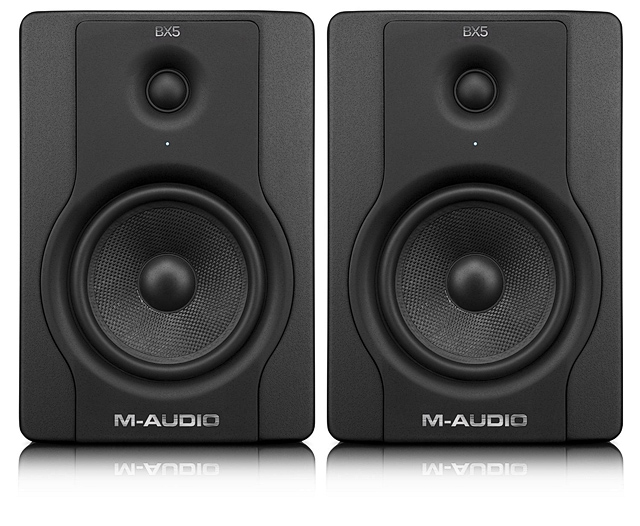
These are handsome units in an understated blend with your gear sort of way: the black finish matches perfectly with my black-trimmed Cinema Display and MOTU Ultralite. The large M-Audio logo is unsightly. Construction appears very good with dense particle board (MDF) cabs, a metal back plate (heat sink benefit), and matching plastic front molding around the drivers. The cabs are covered with a satin black vinyl. These monitors are petite and smaller than most speakers with the same-sized bass driver. For example, they're smaller than the KRK Rokit 5.
The bass drivers are Kevlar with rubber surrounds (tougher than foam!) and the tweeters sport silk domes. No protective grill or covers as usual for mixing monitors. The nekid drivers can be easily damaged by a careless finger or chopstick.
Connectivity
Like most studio monitors, the BX5 comes with pro audio style jacks for 1/4 inch phone plug/TRS and XLR. If you're a novice recordist buying these for general computer use, be forewarned there are no stereo mini jacks, RCA or USB. So you will need to pay extra for a set of special cables and adapters. If you're an experienced recordist, you should have plenty of these cables laying around but, otherwise, be prepared to reach for your wallet.
One of the things I like about the BX5 is that it has both TRS and XLR inputs, allowing connection to two different sources without swapping cables or flipping switches. I have an iFi DAC connected to the TRS input for iTunes, movies, games, etc., while a Tascam Series 208i for recording and mixing is plugged into the XLR connection.
Final Blurb
Yes, the Focal and Adam speakers I crave are better sounding and louder but cost a couple toes and a month of lunches. However, a perfect monitor for a home studio isn't only about a neutral sound, but also about compactness, appearance and value. And the BX5 nails most of these while still sounding decent.
My First Mix
This track is an excuse to show off my ensemble, the Frary Guitar Duo. The recording was made on a Tascam DR100 (mics on stage), edited in Bias Peak Pro 7 and the resulting tweaked tracked synced to the Adobe Premiere video file.
1/8/2026 Update: Still going strong for the past 13 years!
Features and Specs
• Bi-amplified with 70 watts: 40 watts for bass and 30 watts for tweeter
• 5 inch low-frequency drivers with Kevlar cones
• 1 inch high-frequency drivers with silk domes
• Rear facing ports for extended low-frequency response
• Magnetic and RFI shielding
• XLR balanced and 1/4” balanced/unbalanced inputs
• 53 Hz – 22 kHz frequency response
• crossover frequency 3 kHz
• AC selection switch for 115V ~50/60 Hz or 230V ~50/60 Hz
• Output current limiting and over temperature shutdown
• 7.7” x 7” x 10”; 19.5cm x 17.6cm x 25.2cm
• 11 lbs./unit; 5 kg
 •••••••
 •••••••
 •••••••
 •••••••
 •••••••
 Sound Characteristics
 Construction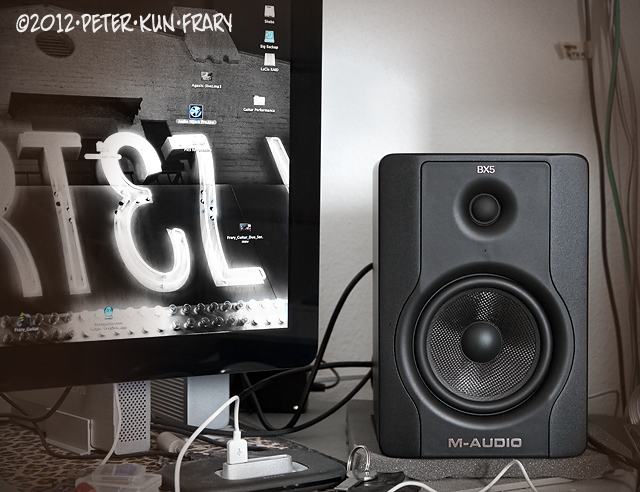
 Connectivity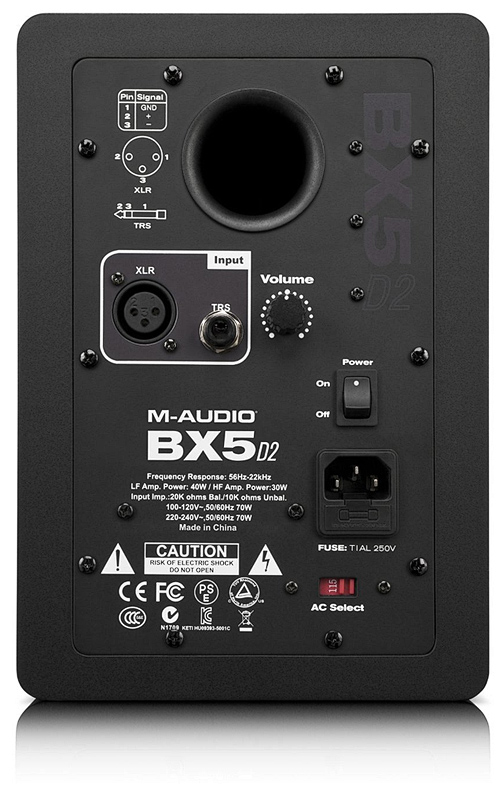
 Final Blurb
 Features and Specs