My old MOTU Ultralite audio interface was limping along with a Firewire connection so I bought a Tascam US 4x4 audio recording interface to replace it because my new Mac lacked Firewire. After tracking with it in my home studio for a few months I added a Tascam US 2x2 to my office: same interface design and specs as the US 2x2 but with more inputs. Here are my thoughts on these devices after a couple years of use.
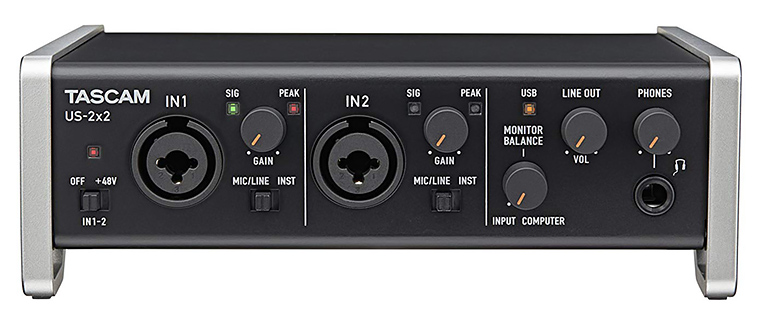
Tascam US 2x2 | The US 2x2 debuted in 2014 | Image courtesy Tascam
What is an Audio Interface?
An audio interface is simply a hardware device that converts sound from microphones and musical instruments into digital data for your computer and vice versa, converting digital audio back into analog signals for headphone and speaker playback.
Tascam US 4x4 | Twice the inputs/outputs | Image courtesy Tascam
Construction
Build quality of both the US 4x4 and US 2x2 are excellent, especially considering the low price: beefy steel case, aluminum tilt stand and knobs and switches for all basic functions. The gently tilted face is easier to see and use compared to right angle face plates. Tascam has made the most of US 4x4 design aesthetics, incorporating the form factor and style in four other models: US 2x2, Series 208i, Series 102i, and the US 16x8.
Controls
Knobs and switches have no wobble or play. Ditto for the outputs and inputs. All major functions have physical controls, and these controls are reasonably spaced and labeled. Signal input (green) and clip (red) LEDs are provided for each XLR channel, but there are no meters. A DAW is required for precise gain staging.
The Sound of Silence | Paul Simon | Kala Honduran Mahogany Doghair Tenor | Neumann KM 184 mics, Tascam US 4x4 and Logic Pro
Connectivity
Inputs
Audio input for the US 2x2 is via two front-mounted XLR combo jacks with integrated TRS inputs for line-level signals or instruments. The US 4x4 has XLR inputs and separate TSR inputs for each of the four channels. Both interfaces use a single 48V phantom power switch for all channels.
Minuet in G (Bach) | Tiny Tenor 6 String | Neumann KM 184 mics, Tascam US 4x4 and Logic Pro
Outputs
US 2x2 otput is via a full sized (1/4") stereo headphone jack and 2 TSR mains (left and right) to feed powered monitors or a mixer. The US 4X4 sports four balanced TSR out and two headphone jacks. Save for the number of input/output ports, operation, specs and sound are the same for both units. Tascam even uses the same manual for both.
Finally, both models boast MIDI in/out for connection of MIDI devices such as controllers and synths.
Tascam US 4x4 Back Panel | | Image courtesy Tascam
Aggregate Device
If you're a Mac user, you can also add more input channels to any audio interface by creating an Aggregate Device. This process works by using Apple's Audio MIDI Setup app (Applications>Utility folder) to link multiple audio interfaces. Most home recordists have a spare audio interface at hand for the occasional session when a few more inputs are needed.
Power
The US 2x2 may be powered through the USB bus or a wall wart. For USB power, it must be connected to a computer or powered USB hub. I wish it had a power switch as it's silly to leave it on when not in use. However, if plugged directly into a Mac, it powers down during sleep or shutdown. If plugged into a powered USB hub, it remains on but can be switched off by powering down the hub or the individual port. The rear panel sports a wall wart input—required for iPad use—but the wall wart isn't included.
Minuet | Joseph Haydn | Kala Mahogany Doghair Tenor | Neumann KM 184 mics, Tascam US 4x4 and Logic Pro
The US 4X4 requires a wall wart power supply due to the energy demands of four XLR inputs with phantom power. Like the 2X2, the 4X4 lacks a power switch. I use a power tap so I can keep it turned off when not being used. Oddly, the the 4X4 doesn't ship with a USB cable. Be prepared for a trip to the store if you don't have a spare cable.
Mac Drivers Not Needed
These Tascam units are Core Audio compliant and, thus, plug 'n play on the Mac, i.e., no drivers needed. Windows need drivers. I've tracked with Bias Peak Pro 7, TwistedWave, GarageBand, Abelton Live and Logic Pro X. It probably works fine with many other apps but that's all I own. Thus far, plug ’n play has worked perfectly from OS 10.9 to 15.7. Power on the interface prior to opening your DAW and it is recognized.
Can't Help Falling in Love | Tiny Tenor 6 String, bass and small percussion | Neumann KM 184 mics, Tascam US 4x4 and Logic Pro
Other units I’ve owned—e.g., MOTU UltraLite and Zoom—needed drivers from the manufacturer, requiring computer restarts for the interface to be recognized and frequent glitches during OS updates and new computer purchases.
Sound Quality
I use these interfaces for stereo and multi-track recordings of my guitar and ukulele. Audio quality of the US 2x2 and 4X4 are identical and similar to the Tascam DR-60 MK and DR-44WL, albeit the US 2x2 and 4X4 have cleaner mic preamps.
Monitoring
I have the TRS mains routed to my M-Audio BX5 for monitoring and mixing. The Tascam DAC renders audio accurately albeit slightly brighter compared to my MOTU Ultralite. The headphone amp sounds good and has plenty of gain to drive my old Sennheiser HD580 headphones.
Through The Eyes of Love | Tiny Tenor 6 String Koa | Neumann KM 184 and TLM 102 mics, Tascam US 4x4, Logic Pro X and Canon 80D.
Use the Monitor Balance knob to adjust the balance between the input jacks (your playing) and the output from the computer. Set to the far right, you hear only computer playback. Set to the extreme left, you hear only the input signal and have zero latency. Latency may be minimized by combining input and computer sources in the monitor feed. I prefer the mix at 10:00 to 11:00, with a little stronger input signal but with computer playback still audible.
Preamps
Tascam's Ultra-HDDA mic preamps are exceptionally clean and RFI-resistant. I don't have a lot of mics to test, but the preamps have more than enough gain for the Neumann KM184, Neumann TLM 102, and AKG C3000B, all condenser mics. Gain falls a little short for most dynamic mics. You need a Fethead for the SM7B. However, cranked wide open, gain is okay for acoustic guitar when using higher output dynamics like the Shure Beta 57 or KSM 8.
Final Blurb
Both the Tascam US 2x2 and US 4X4 are sturdy and well constructed, don't require drivers on Macs, are easy to operate, are modestly priced, and record audio cleanly and accurately.
Walk, Don't Run | Kala Honduran Mahogany Doghair Tenor | Neumann KM 184 mics, Tascam US 2x2 and Logic Pro
December 2020 Update: Tascam upgraded the US 4X4, raised the price and renamed it the US-4x4HR. Same physical appearance but with 192 kHz sampling rate, improved S/N ratio and USB-C for both data and power. The physical controls and inputs/outputs remain the same.
March 2022 Update: The channel 1 preamp died in my US 4X4 so I upgraded to the higher spec Tascam Series 208i. My US 2X2 is on office duty and going strong.
Features and Specs
US 2X2
Two Ultra-HDDA mic/line preamps (57dB of gain)
Two XLR and TRS inputs
Two TRS mains out
MIDI in/out
Headphone jack
(1/4")
Up to 96kHz/24-bit WAV recording (44.1, 88.2 and 96)
S/N Ratio: 101 dB or more (MIC/LINE IN to LINE OUT, gain knob at MIN, JEITA)
USB 2.0 port (USB 3.0 compatible) and external power port
Zero-latency Direct Monitoring
MAP: $150
USD
US 4X4
Four Ultra-HDDA mic/line preamp (57dB of gain)
Four XLR and four TRS inputs
Four TRS mains out
MIDI in/out
Two Headphone jacks (1/4")
Up to 96kHz/24-bit WAV recording (44.1, 88.2 and 96)
S/N Ratio: 101 dB or more (MIC/LINE IN to LINE OUT, gain knob at MIN, JEITA)
USB 2.0 port (USB 3.0 compatible) and external power port
Zero-latency Direct Monitoring
MAP: $200 USD
Scarborough Fair | Tiny Tenor 6 String (melody and harmony) and Baritone 6 (intro/outro) | Neumann KM 184 mics, Tascam US 4x4 and Logic Pro
 •••••••
 •••••••
 •••••••
 •••••••
 •••••••
 What is an Audio Interface?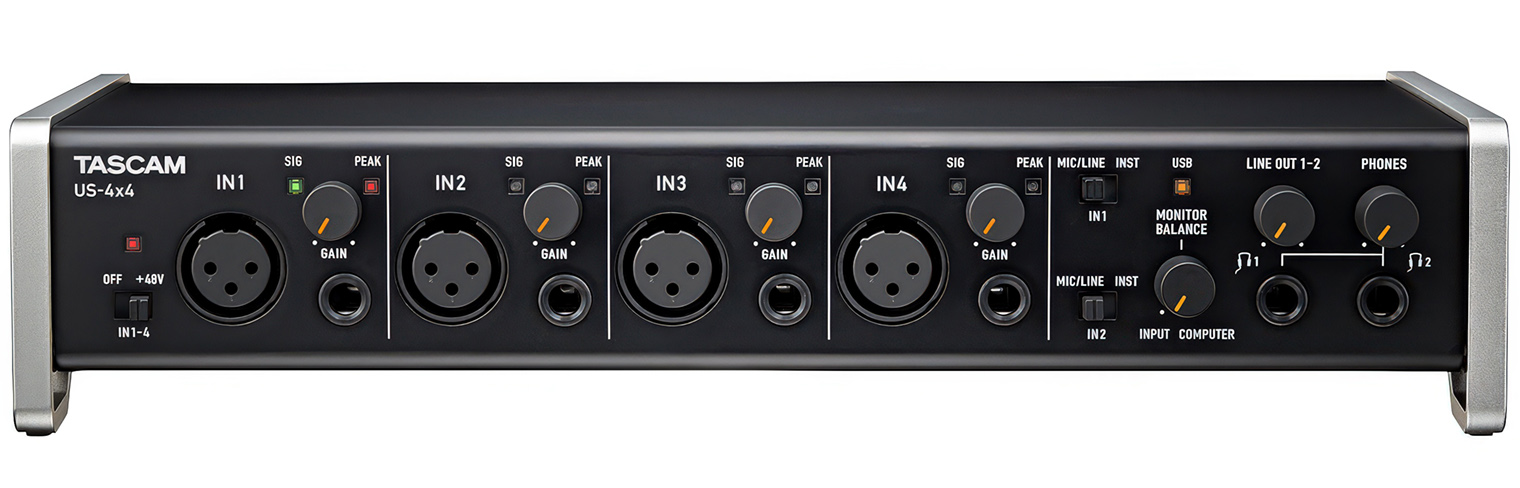
 Controls
 The Sound of Silence
 Inputs
 Outputs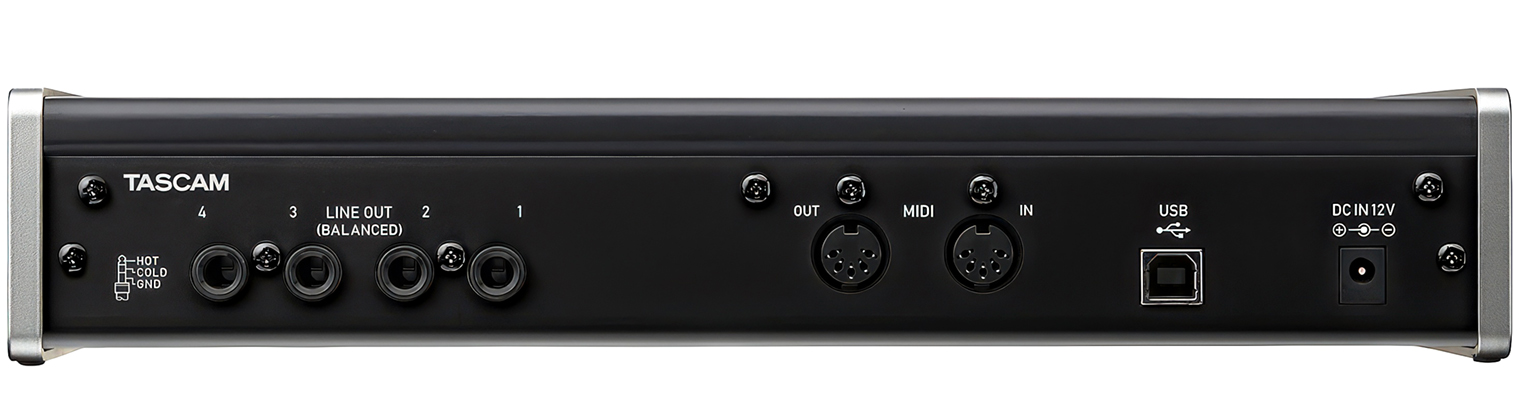
 Aggregate Device
  Power
Power Mac Drivers Not Needed
 Sound Quality
 Final Blurb